Showing posts with label history. Show all posts

Monday, 23 April 2018

H is for Hawk quote

I once asked my friends if they'd ever held things that gave them a spooky sense of history. Ancient pots with thousand-year-old thumbprints in the clay, said one. Antique keys, another. Clay pipes. Dancing shoes from WWII. Roman coins I found in a field. Old bus tickets in second-hand books. Everyone agreed that what these small things did was strangely intimate; they gave them the sense, as they picked them up and turned them in their fingers, of another person, an unknown person a long time ago, who had held that object in their hands. You don't know anything about them, but you feel the other person's there, one friend told me. It's like all the years between you and them disappear. Like you become them somehow. 
Helen Macdonald, H is for Hawk

Wednesday, 1 October 2014

"It is not easy for the historian..."

"It is not easy for the historian, ten, fifty or five hundred years away from an event, to put aside for a moment the large concepts of currents and forces, or the mechanical aids of statistics, charts, maps, neat plans and diagrams in which the migration of men, women and children is indicated by an arrow, or a brigade of half-terrified, half-heroic men becomes a neat little rectangle. It is not easy to see behind source material, to visualise state papers, reports, letters, diaries as written by men who spent most of their lives sleeping, eating, yawning, eliminating, squeezing blackheads, lusting, looking out of windows, or talking about nothing in general with no one in particular. We are too impressed by the pattern revealed to us - or which we think has been revealed to us - to remember that for the participants history is a haphazard affair, apparently aimless, produced by human beings whose concern is essentially with the trivial and irrelevant. The historian is always conscious of destiny. The participants rarely - or mistakenly." 
Ward Moore, Bring the Jubliee

Friday, 26 September 2014

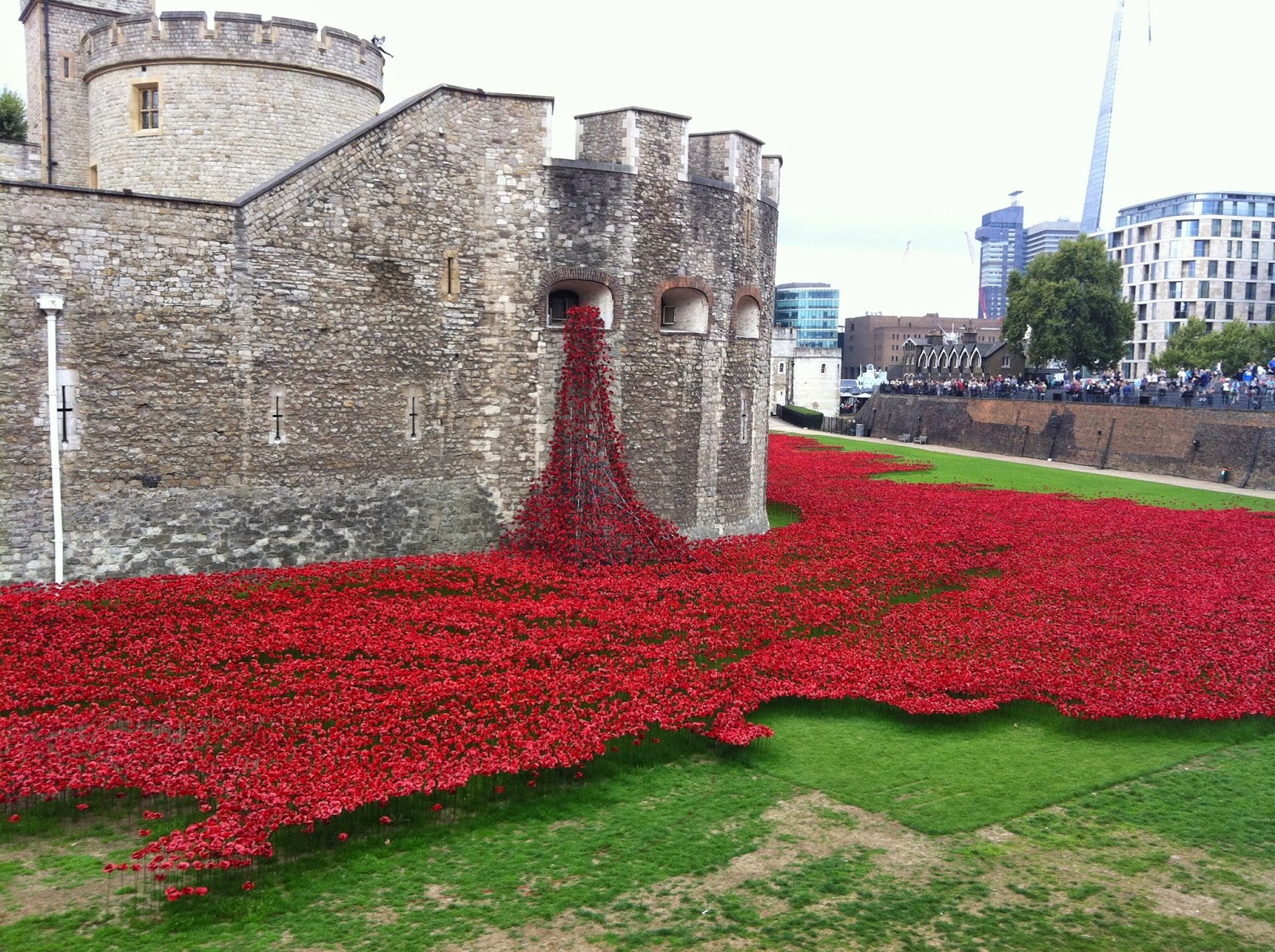
The Tower of London Remembers

We're currently drowning in cultural representations of the First World War.

Actually, no, a complaint probably isn't the best way to frame this.

(And I certainly wouldn't wish to align myself with the Michael Goves of this world!)

But it's the image which my mind immediately jumps for when I think about it. With the anniversary of the start of hostilities this year, it was inevitable that many people would wish to commemorate it in some way. And I don't wish to suggest that such work isn't worthwhile.

Quite apart from anything else, a friend has got his first television role as an actor in a BBC production which will be showing later this year.

Still, thinking specifically about the BBC project of which that drama is a part, a season of programming which is running over the next four years, the largest project the BBC has ever engaged in: there's something a little bit off about it isn't there? The huge resources, the attention paid to all aspects of the conflict (or the attempt to do so at any rate). Something about it puts me off.

It's partly to do with the way in which the First World War has been remembered. It's the suffering of the ordinary soldier in the trenches which has been made the central image of how the conflict has been memorialised. Too much attention on this central fact feels like it runs the risk of becoming prurient, of taking that experience for granted. There's a crucial aspect of respect which is found in any worthwhile representation of the First World War.

And the War is a major part of the culture of the last century anyway, as both subject and backdrop, that the extra, excessive attention being given to it now almost seems unnecessary. Poetry of the First World War was some of the first, grown up, poetry I ever encountered, at primary school. The conflict is now, incontrovertibly history - no one who fought in the trenches is still alive - and yet still it seems like a central event in the culture of the century which followed. It's why it still feels why the fight over how the conflict should be remembered still feels important. In comparison, the way in which the Second World War is memorialised feels as if it is far more settled. Not that there aren't arguments to be had over it, but they seem less central to it's representations. Where the first War has been defined and memorialised in terms of the suffering of ordinary soldiers in the trenches, the second has been defined as the defeat of an enemy, Nazi Germany, a victory of which few would challenge the justice. It's easier to see Second World War as a good or just war (however you wish to define, or question, such a term) than it is the First. Britain did eventually win the First World War, but the victorious battles haven't lasted in our cultural consciousness alongside the battles of which nobody 'won', achieving little more than a senseless loss of life.

I might well be wrong here of course, but assuming we can even imagine what the television culture of 2039 is going to look like, do we really imagine that the BBC will lavish such attention on the  anniversary of the conflict we'll be remembering then? It will surely be remembered differently.

So something about it bothers me, even if I can't quite put my finger on what it is here. And even though I appreciate much of the work which is concerned with representing the War. So when my wife told me that she wanted to see the Tower of London ceramic poppy field when we were down in London a few weeks ago, my initial reaction  was rather dismissive. It felt gimmicky, precisely the kind of memorialising I would prefer to avoid.

Anyway, I was wrong. It's utterly magnificent. It shouldn't work, yet somehow, faced with the reality, these massed ranks of delicate, beautiful works of art, it achieves something extraordinary. The meaning is obvious: the tension between the delicacy of the ceramic poppies - so much more delicate than a real flower - and the heavy destructiveness of the machinery that destroyed the bodies of so many millions. That it's obvious does nothing to diminish it's power.


Photographs can't really do it justice. It has to be seen.

Tuesday, 22 October 2013

Amit Chaudhuri quotes

It was before history was born, and he himself became who he was, studying in a city that is always pre-natal, pre-nascent....It is as if my father came into being from fantasy, like an image, in 1923. Yet it is an image full of truth, to think of him studying in Calcutta, or taking a tram-ride, one of the marginal, anonymous people who were neighbours with history, one of millions, studying, discussing politics, listening to songs, living in hostel rooms, eating in the 'cabins' of North Calcuttam who were bypassed and yet changed, without their names or the quality of those moments ever being known, by independence and partition. So India took on a new shape, and another story began, with homelands becoming fantasies, never to be returned to or remembered. 
Afternoon Raag (1993)

History is not the annals; it's what happens around us when we're unaware it's history.
Calcutta: Two Years in the City (2013) 


Wednesday, 3 October 2012

The Golden Age of Children's Fiction (2)

Rosemary Sutcliff, The Silver Branch

The second book in the trilogy 'Three Legions', which I can still remember coming across more than once in my school library. I think I may even have tried to start reading it, but didn't get very far into the first book. It was a copy of the third book in the sequence, The Lantern Bearers, a present in childhood which for some reason I held onto and finally read either during or just after university. So I've encountered them out of order, but really that hardly matters. This isn't much of a trilogy at all, each book taking place at different periods in Roman British history, with little to connect them other the odd subtle link, members of the Aquila family and a silver dolphin seal ring. In fact, if you look at Wikipedia, you can see the series carries on well past this supposed 'trilogy', past the departure of the Roman legions from British shores, up until the Norman conquest, and elsewhere even spinning off into Arthurian fantasy. I shall enjoy following this saga further, as Rosemary Sutcliff really is one of the finest historical novelists I've come across.

It was a rather pompous review of Hilary Mantel's recent Thomas Cromwell novels by James Wood which helped me put my finger on just why Sutcliff's fiction is so successful. I say the review is pompous, because historical fiction, in his words, 'a somewhat gimcrack genre not exactly jammed with greatness', is a genre he clearly looks down upon. This is his accounting for Hilary Mantel's success:
Where much historical fiction gets entangled in the simulation of historical authenticity, Mantel bypasses those knots of concoction, and proceeds as if authenticity were magic rather than a science. She knows that what gives fiction its vitality is not the accurate detail but the animate one, and that novelists are creators, not coroners, of the human case. In effect, she proceeds as if the past five hundred years were a relatively trivial interval in the annals of human motivation.
But that surely, is the measure of success of a great deal of historical fiction? Having so little time for the genre, Woods compares Mantel's achievement to the work of Peter Ackroyd and Susan Sontag. Now, I'm unfamiliar with Susan Sontag's fiction, but I've read a lot of Peter Ackroyd's work, and it seems to me that he is engaged on an entirely different project, his approach to historical fiction being that of a lively pastiche, enjoying the feel of the language. They are entirely literary games, but then he, like I imagine Susan Sontag, is writing historical fiction post-The Name of the Rose, which might be seen as the marker for the new type of historical fiction which started to be written in the 80s. I wish I'd kept a link to the academic book I found online which delineated this tradition of a 'new historical fiction'. The point I think is that it encompassed a new self-consciousness about narrative, and particularly about language. Hence the profusion of literary pastiche. Of course, this development occurred alongside the development of modern 'literary' fiction, with which it shares many characteristics.

Which isn't to say that people didn't carry on writing the older type of historical fiction, particularly in the genres. We even had the creation of the historical crime story. It's just to note that there's nothing 'mysterious' about Hilary Mantel's achievement. It's exactly the same kind of achievement you can find in a novel published for children in the late-1950s. I've no idea if Rosemary Sutcliff's fictional representation of Roman Britain is true exactly, even if I went through and checked every little detail against the known archaeological and historical facts. But it feels true, as if this must be how it felt to be alive at the time, because all of the human motivations and feelings feel wholly recognisable.

What I also recognise is the time in which it was written. These 'Roman' novels are a portrait of an empire in decline written by the subject of another empire also in the process of decline. A theme which becomes more prominent in The Lantern Bearers is the need to preserve the 'light' of civilisation against the darkness of the surrounding barbarism, is introduced here through the character of the self-proclaimed British emperor Carausius, whose motivation for his declaration is precisely that: a self-conscious attempt to halt, if only temporarily, a slide from civilisation into barbarism. It should come as no surprise that Rosemary Sutcliff wrote a book on Rudyard Kipling, and counted him as a major influence.

*

Susan Cooper, The Dark is Rising

When my wife read the Over Sea, Under Stone, she described it to me as like The Famous Five crossed with The Lord of the Rings. A description I loved. She then proceeded to read the entire series over the course of the last week.

In contrast to the first book, here we're thrown into the magic world underpinning the real one within the first twenty pages or so, as Will Stanton, seventh son of a seventh son, quickly learns that he is in fact one of the 'Old Ones', a secret society of immortal beings who protect the world from the forces of the 'Dark'. The main action of the book can easily be reduced to a kind of 'schooling of a sorcerer' as Will learns of his secret heritage through a series of infodumps and collects a series of plot-coupons which will preserve the world for the forces of light until the next time the Dark attacks. That it doesn't feel shcematic is entirely to the credit of Susan Cooper's ability both to tell a story and root it in a richly imagined world.

Whilst the Light is characterised by a patchwork of characters drawn from myths which have attached themselves to the British land - Merlin, Herne the Hunter, Wayland the Smith, even Arthur (or so I assume; he isn't named here, presumably to reappear later in the sequence?), the Dark is largely amorphous, a mysterious threatening entropic force. The characters we meet who are on the side of the Dark only serve it, they don't embody it in the way that those of the light appear do. The character who comes closest to such a role is the mysterious 'Dark Rider' who appears as a Mr. Mithothin (or, 'Myth'-o-thin, embodying the entropic quality of the Dark).

As with the earlier book, there's a wonderful sense here of another world existing behind the cover of the world we see in front of us every day. Here though, we get to see what that world actually looks like, with it's surreal trips into the past. Again, it's not just myth, but the presence of the past which is impinging on the present. I love how so much of this sense of the numinous appears to be conveyed through music. There's so much music in this book: carols (it is set at Christmas), church music, a setting of A.E. Housmann, Greensleeves (which seems to be related to the mysterious tune Will hears at moments of greatest significance), even the Hunting of the Wren. The use of music matches the way in which, whenever magic appears in the narrative, Cooper's writing becomes diffuse, in contrast to the rootedness in a realistic sense of place and character she employs elsewhere. The picture of what's going on becomes a little unclear, like a half remembered song.

*

I know from a piece I read in Alan Garner's essay collection The Voice That Thunders, that one of the common experiences shared by all of the writers who came to prominence in the golden age of children's fiction in the 60s and 70s is that of having grown up with the experience of the Second World War. Certainly, there is something of the spirit of the Blitz in the way in which the Dark is presented:
He saw one race after another come attacking his island country, bringing each time the malevolence of the Dark with them, wave after wave of ships rushing inexorably at the shores. Each wave of men in turn grew peaceful as it grew to know and love the land, so that the Light flourished again. But always the Dark was there, swelling and waning, gaining a new Lord of the Dark whenever a man deliberately chose to be changed into something more dread and powerful than his fellows. Such creatures were not born to their doom, like the Old Ones, but chose it. 
...He saw a time when the first great testing of the light came, and the Old Ones spent themselves for three centuries on bringing their land out of the Dark, with the help in the end of their greatest leader, lost in the saving unless one day he might wake and return again.
My wife (the medieval historian in the family) tells me that the imagery of waves of ships comes straight from Bede and Gildas. I don't doubt that you're right about that my dear, it's clearly an echo of the popular image of the Viking raids, but I also think that such imagery must have seemed particularly apt to someone who had lived through the Second World War as a child and to a readership growing up in it's aftermath (and in Britain the aftermath of the Second World War lasted well into the 60s; in fact, in some ways, culturally we're still living in that aftermath). The evil that the Dark represents is never explicitly defined, allowing it carry a multitude of metaphorical possibilities.

As well as World War Two, they also belonged to the generation which grew up celebrating Empire Day, before it was superseded by Commonwealth Day. They belonged to the last generation for whom the British Empire was an inescapable fact, part of the furniture which made up the cultural background. Will's older brother Stephen is in the British navy, stationed out in the West Indies, where he meets a magic foreigner who gives him one of the essential items Will needs to complete his quest. It's a very odd moment. I mean, what on earth is an avatar of Herne the Hunter doing there? It feels like a somewhat clumsy attempt to make a story which is otherwise intensely focused on the matter of Britain a little more universal.

In the imagery Susan Cooper deploys above, she's also using essentially the same symbolism as Rosemary Sutcliff. Civilisation is the 'light' which has to be protected against the Dark. And these quasi-aristocratic Old Ones are born not made, defending a light which is centred on this island nation. It's appropriate that there's a degree of Royal symbolism floating about the narrative. Which is not to say that it doesn't also complicate and simple assumption about the definition of the British nation and forces of the Light. Arthur, assuming it is he, is described by Merriman as 'part-Viking', suggesting a mingling of the native and foreign. And the forces of the Light aren't always kind. The figure of the Walker, condemned to walk through the centuries because he betrayed his master's trust, is hugely sympathetic; his actions, his choice of the dark, the result of the way his trust had been abused by his former master.

That ultimately, is what is so refreshing about Cooper's conception of the Dark. It is, ultimately, always a matter of choice, not something which is intrinsic to an invading race or person. In time, the invader's settle down. Evil is contingent.

Monday, 5 March 2012

England, c. 1399-1422.

English inns had the reputation of being warm and welcoming: foreign visitors commented that (amazing as it might seem to us) hostesses greeted guests with kisses.

Miri Rubin, The Hollow Crown: A History of Britain in the Late Middle Ages

Tuesday, 20 December 2011

The Scarlet Pimpernel...& the pleasures of cheap print.

Sir Percy Blakeny, as the chronicles of the time inform us, was, in this year of grace 1792, still a year or two on the right side of thirty. Tall, above the average, even for an Englishman, broad-shouldered and massively built, he would have been called unusually good-looking, but for a certain lazy expression in his deep set blue eyes, and that perpetual inane laugh which seemed to disfigure his strong, clearly cut mouth.
It's seems silly to criticise Baroness Orczy for demonising the French revolution and idealising the aristocracy. That's surely what you would expect from a novel like this. And the writing seems to anticipate such criticism somehow. There's an arch tone of voice, particularly in the earlier chapters, a theatricality throughout, particularly in the hero's impossibly successful disguises, which alerts you to the fact that this is history as a charade, as costume drama. The climax strains credulity with the stupidity of the French revolutionary soldiers. The twenty strong 'League of the Scarlet Pimpernel' are all noble young men enjoying themselves, just as they would at hounds, or some similar sport, performing their daring exploits largely for the fun of it. It's history played as a game.

Being familiar only with a vague outline of the character, it was interesting to see just how much of the story is actually more a romance, concerned far more with the feelings of Lady Blakeny than anything else, for all that it contains it's fair share of adventure.

I almost certainly wouldn't have read it if I hadn't come across a cheap paperback from the 60s in a charity shop, with a wonderful painted cover. The kind you don't really get anymore. The vivid red of the Pimpernel's coat dominates the composition. The materiality of the text added to the nostalgia of the story's love of the aristocracy. Compare Baroness Orczy with Sabatini. If it came to the quality of the writing I'd probably choose Sabatini over Orczy. He's got just a better command of language. Yet my copy of Captain Blood is the most recently republished Vintage edition. It's wonderfully designed, but the form doesn't match the charm of the adventure story. It should be old, preferably printed in a time before I was born, because that's where the adventure story belongs for me. It's surely for precisely that reason that the British covers to the Captain Alatriste series evoke older pulp conventions. Form matches content, only it can never quite match the real thing because it's too obviously the product of nostalgia. The old pulp covers weren't trying to evoke anything, other than attempting to sell you the book. Trying to evoke the idiom is fine, but there's always an air of self consciousness about it. This 1960s cover for The Scarlet Pimpernel simply is.

I'm also fascinated by the other titles recommended at the back. I've never read Naomi Mitchison or Geoffrey Trease, but both sound intriguing. Clearly there was this whole tradition of historical fiction which has rather faded from view now, perhaps through the rise of a more self-consciously meta fictional historical fiction over the last thirty years. I'm not talking about historical romance here, which has clearly continued to flourish despite whatever literary fashion might have to say. I'd put Henry Treece in the same grouping, a writer I have read.

Best of all though is the description quoted for Elizabeth Goudge's Linnets and Valerians, quoted from The Observer:
Four children (Mother dead, Father in India). Scholarly bachelor uncle decides - with aid of wise old gardener-factotum - to educate them. But beware of Lion Tor, and the mist when it takes strange shapes over Weeping Marsh. And where is Lady Valerian's lost explorer husband?
I love the peremptory tone of it, the faint echo of the opening of Bleak House. The assumptions of the reviewer. It comes straight out of the Empire. "Thrilling stuff" no doubt; you needn't read the book, just let the breathless prĂ©cis do all the work of the story.

I've always loved these advertisements for other other writers, other books, which used to appear in the back of the book. The promise of more books beyond the one you've just finished. It's something else I don't think we get so much any more, unless it's adverts for more books by the same author as the book you've just finished reading.

The promise of more books beyond the one you've just finished reading. Or the book you're still reading, if you've flicked to back while still only half way through. It's the promise that this wonderful adventure that is reading and that is never going to end.